Adjoint functor
An adjunction of functors is an adjunction in
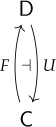
or compactly
When adjoints exist they are unique up to natural isomorphism,
hence we call
Proof of uniqueness
By duality, it suffices to prove right adjoints are unique up to natural isomorphism.
Suppose
hence for any object
naturally and thus
naturally (see Yoneda embedding).
The name comes from an analogy to the Adjoint operator.
In the archetypal examples, we think of
Unit and coünit
We can equivalently rephrase the condition for an adjunction in terms of a unit or coünit, so named since they form the corresponding data for a monad or comonad induced by the adjunction respectively.
-
There exists a natural transformation
𝜂 : 1 ⇒ 𝑈 𝐹 : 𝖢 → 𝖢 𝐶 ∈ 𝖢 𝐷 ∈ 𝖣 𝑓 ∈ 𝖢 ( 𝐶 , 𝑈 𝐷 ) 𝑓 ♯ ∈ 𝖣 ( 𝐹 𝐶 , 𝐷 ) 𝑓 = ( 𝑈 𝑓 ♯ ) 𝜂 𝐶 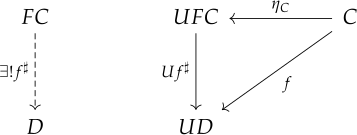
-
There exists a natural transformation
𝜖 : 𝐹 𝑈 ⇒ 1 : 𝖢 → 𝖢 𝐶 ∈ 𝖢 𝐷 ∈ 𝖣 𝑔 ∈ 𝖣 ( 𝐹 𝐶 , 𝐷 ) 𝑔 ♯ ∈ 𝖢 ( 𝐶 , 𝑈 𝐷 ) 𝑔 = 𝜖 𝐷 ( 𝐹 𝑔 ♯ ) 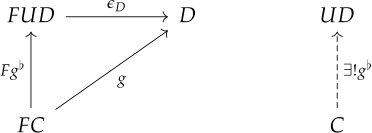
To see that either of these are necessary and sufficient, note2
This gives us another perspective on adjunctions: They are a weakening of Equivalence of categories.
Properties
#state/tidy | #lang/en | #SemBr
Footnotes
-
2010. Category theory, §9 ↩
-
2020. From categories to homotopy theory, p. 40 ↩