2-category theory MOC

Bicategory

A bicategory is motivated from several perspectives:

  1. A bicategory is a category in the next dimension: While categories have a set1 of morphisms between objects, a bicategory has a category of morphisms between objects. Because the objects of each “hom-category” need not form a set, the “identities” involved are higher isomorphisms having coherence relations of their own, similar to the associator and unitors of a monoidal category.
  2. A bicategory is the oidification of a monoidal category, so that each object has a monoidal category of endomorphisms.

Thus, in terms of collections, a bicategory is a mathematical object consisting of: #m/def/cat/bi

  1. a collection of objects, 0;
  2. for any 𝐴,𝐵 0, a category (𝐴,𝐵);
Notation

We call the elements of the collection 1(𝐴,𝐵) :=(𝐴,𝐵)0 1-morphisms, and notate 𝑓 1(𝐴,𝐵) with

𝑓:𝐴𝐵.

For any 𝑓,𝑔 1(𝐴,𝐵) we call the elements of the set 2(𝐴,𝐵)(𝑓,𝑔) :=(𝐴,𝐵)(𝑓,𝑔) 2-morphisms, and notate 𝛽 2(𝐴,𝐵)(𝑓,𝑔) with $$ \beta : f \Rightarrow g : A \to B.

  1. for any 𝐴,𝐵,𝐶 0, a composition bifunctor; ():(𝐵,𝐶)×(𝐴,𝐵)(𝐴,𝐶);
  2. for any 𝐴 0, a distinguished 𝟙𝐴 1(𝐴,𝐴), sometimes by abuse denoted 𝐴;
  3. for any 𝐴,𝐵,𝐶,𝐷 0, a natural isomorphism called the associator with components 𝛼,𝑔,𝑓 :( 𝑔) 𝑓 (𝑔 𝑓) :𝐴 𝐷 for indices 1(𝐶,𝐷), 𝑔 1(𝐵,𝐶), and 𝑓 1(𝐴,𝐵);
  4. for any 𝐴,𝐵 0, a natural isomorphism called the left-unitor with components 𝜆𝑓 :𝟙𝐵 𝑓 𝑓 :𝐴 𝐵 for index 𝑓 (𝐴,𝐵); and
  5. for any 𝐴,𝐵 0, a natural isomorphism called the right-unitor with components 𝜌𝑓 :𝑓 𝟙𝐴 𝑓 :𝐴 𝐵 in index 𝑓 (𝐴,𝐵);

satisfying the so-called triangle identity
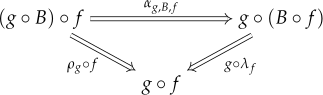
c|https://q.uiver.app/#q=WzAsMyxbMCwwLCIoZyBcXGNpcmMgQikgXFxjaXJjIGYiXSxbMSwxLCJnIFxcY2lyYyBmIl0sWzIsMCwiZyBcXGNpcmMgKEIgXFxjaXJjIGYpIl0sWzAsMiwiXFxhbHBoYV97ZyxCLGZ9IiwwLHsibGV2ZWwiOjJ9XSxbMCwxLCJcXHJob19nIFxcY2lyYyBmIiwyLHsibGV2ZWwiOjJ9XSxbMiwxLCJnIFxcY2lyYyBcXGxhbWJkYV9mIiwwLHsibGV2ZWwiOjJ9XV0=

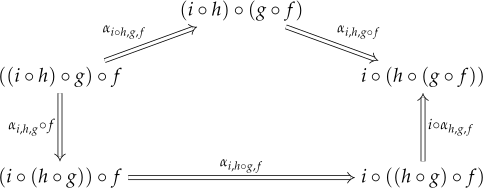
and pentagon identity

c|https://q.uiver.app/#q=WzAsNSxbMCwzLCIoaSBcXGNpcmMgKGggXFxjaXJjIGcpKSBcXGNpcmMgZiJdLFsyLDMsImkgXFxjaXJjICgoaCBcXGNpcmMgZykgXFxjaXJjIGYpIl0sWzAsMSwiKChpIFxcY2lyYyBoKSBcXGNpcmMgZykgXFxjaXJjIGYiXSxbMiwxLCJpIFxcY2lyYyAoaCBcXGNpcmMgKGcgXFxjaXJjIGYpKSJdLFsxLDAsIihpIFxcY2lyYyBoKSBcXGNpcmMgKGcgXFxjaXJjIGYpIl0sWzAsMSwiXFxhbHBoYV97aSxoIFxcY2lyYyBnLGZ9IiwwLHsibGV2ZWwiOjJ9XSxbMiwwLCJcXGFscGhhX3tpLGgsZ30gXFxjaXJjIGYiLDIseyJsZXZlbCI6Mn1dLFsxLDMsImkgXFxjaXJjIFxcYWxwaGFfe2gsZyxmfSIsMix7ImxldmVsIjoyfV0sWzQsMywiXFxhbHBoYV97aSAsaCxnIFxcY2lyYyBmfSIsMCx7ImxldmVsIjoyfV0sWzIsNCwiXFxhbHBoYV97aSBcXGNpcmMgaCxnLGZ9IiwwLHsibGV2ZWwiOjJ9XV0=

for any 𝐴𝑓𝐵𝑔𝐶𝐷𝑖𝐸 in . Together these diagrams ensure that the operation of ( ) is unital associative up to canonical natural isomorphism, by the Coherence theorem for bicategories.

Examples

See also


#state/tidy | #lang/en | #SemBr

Footnotes

  1. Which is the same as a (0,0)-category.