Monoidal internalization

Convolution monoid

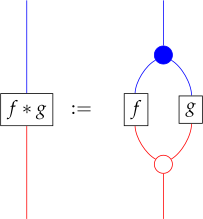
In a monoidal category 𝖒, suppose 𝑅 is a comonoid and 𝐡 is a monoid. Then 𝖒(𝑅,𝐡) is a monoid in 𝖲𝖾𝗍 under the product
c

with the unit πœ‚πœ–. #m/thm/cat This is called the convolution monoid on 𝖒(𝑅,𝐡).

Proof

Associativity follows directly from the coΓ€ssociative law law of 𝑅 and associative law of 𝐡. Unitality follows directly from the coΓΌnit law of 𝑅 and unit law of 𝐡.

Note that when 𝑅 =𝐡 is a bimonoid, we have two in general distinct monoid structures on End𝖒⁑(𝑅): Composition ( ∘) and convolution ( βˆ—).

Submonoids

If 𝑅 is a bimonoid and 𝐡 is commutative, then π–¬π—ˆπ—‡π–’(𝑅,𝐡) is a submonoid of the convolution monoid 𝖒(𝑅,𝐡). #m/thm/cat

Proof

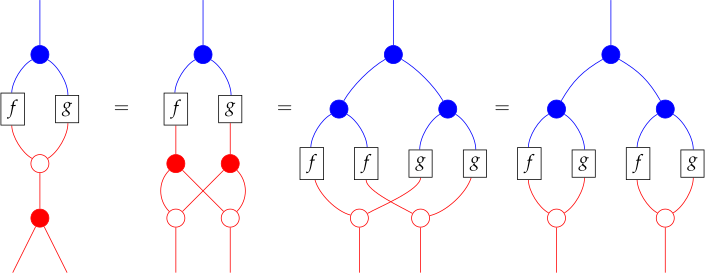
By the definition of a bimonoid, πœ– βˆˆπ–¬π—ˆπ—‡π–’(𝑅,πŸ™), and clearly πœ‚ βˆˆπ–¬π—ˆπ—‡π–’(πŸ™,𝐡), so πœ‚πœ– βˆˆπ–¬π—ˆπ—‡π–’(𝑅,𝐡). On the other hand, using commutativity of 𝐡 we have
c

whence the convolution of monoid morphisms is a monoid morphism.

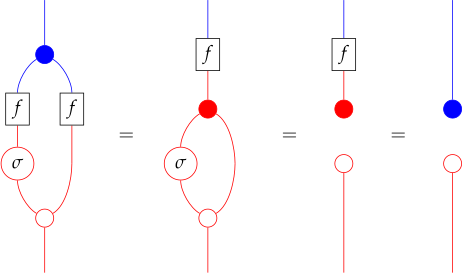
Moreover, if 𝑅 is a Hopf monoid with antipous 𝜎, then π–¬π—ˆπ—‡π–’(𝑅,𝐡) is a group, where the inverse of 𝑓 βˆˆπ–¬π—ˆπ—‡π–’(𝑅,𝐡) is given by π‘“πœŽ. #m/thm/cat

Proof

That π‘“πœŽ βˆ—π‘“ =πœ‚πœ– is shown by

c

and the proof that 𝑓 βˆ—π‘“πœŽ =πœ‚πœ– is analogous.


#state/tidy| #lang/en | #SemBr