Monoidal category

Duality in a monoidal category

Let 𝑋 and π‘Œ be objects in a monoidal category 𝖒. A duality π‘Œ βŠ£π‘‹ consists of morphisms

ev:π‘‹βŠ—π‘‹β†’πŸ™coΓ«v:πŸ™β†’π‘‹βŠ—π‘Œ

called evaluation and coΓ«valuation satisfying the zigzag identities

(π‘ŒβŠ—coΓ«v)βˆ˜π›Όβˆ’1π‘Œπ‘‹π‘Œβˆ˜(evβŠ—π‘Œ)=πœŒπ‘Œβˆ˜πœ†βˆ’1π‘Œ(coΓ«vβŠ—π‘‹)βˆ˜π›Όπ‘‹π‘Œπ‘‹βˆ˜(π‘‹βŠ—ev)=πœ†π‘‹βˆ˜πœŒβˆ’1𝑋
String diagrams

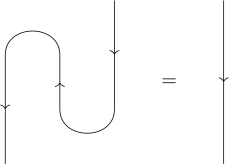
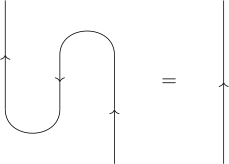
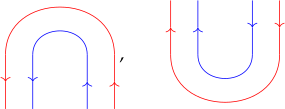
Representing 𝑋 as strings going upwards, π‘Œ as strings going dowards, evaluation as a cap and coΓ«valuation as a cup, the zigzag identities become

c

and

c

hence the name

π‘Œ is thence called a left dual of 𝑋 and 𝑋 a right dual of π‘Œ.1 An object with a left or right dual is called dualizable. Left and right duals are unique up to unique isomorphism, thus one sometimes speak of the left dual π‘‹βˆ— =π‘Œ or the right dual βˆ—π‘Œ =𝑋.

Proof of uniqueness

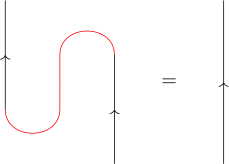
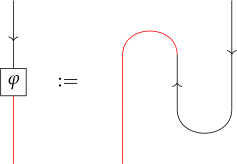
We prove the left case, the left case is symmetrical. Suppose π‘Œ βŠ£π‘‹ with the string diagrammatic notation given above but also 𝑅 βŠ£π‘‹ so that
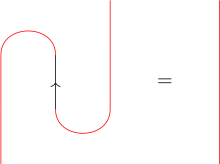
c

and

c

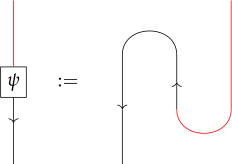
Letting

c

and

c

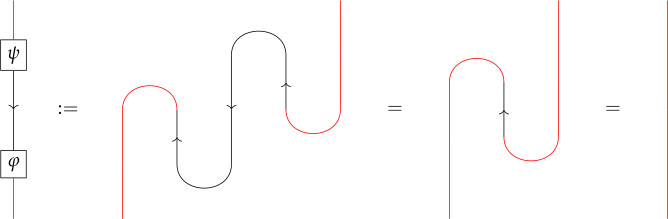
we have

c

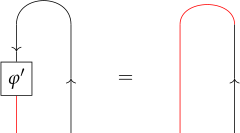
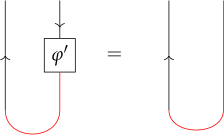
i.e. πœ“πœ‘ =1𝑅. A symmetric argument shows πœ‘πœ“ =1π‘Œ, whence πœ‘ is an isomorphism. Moreover, πœ‘ is uniquely determined by the compatibility conditions

c

and

c

since the zigzag identities give precisely πœ‘β€² =πœ“βˆ’1 and thus by uniqueness of inverses πœ‘ =πœ‘β€².

One also calles an object a left or right dual if it has a right or left dual respectively. A monoidal category 𝖒 is called

Functoriality

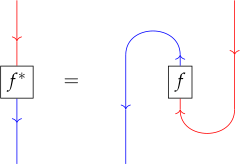
If 𝑅 and 𝐡 are right duals, and 𝑓 :𝑅 →𝐡 is a morphism, we can define the left dual π‘“βˆ— :π΅βˆ— β†’π‘…βˆ—.

c

Moreover if 𝖒, the left dual of 𝑅 βŠ—π΅ is naturally isomorphic to π΅βˆ— βŠ—π‘…βˆ—, where evaluation and coΓ«valuation are

c

respectively.

See also


#state/tidy | #lang/en | #SemBr

Footnotes

  1. Caveat emptor, the conventions for notation and terminology vary a lot here. We have chosen our left and right duals to be consistent with left and right adjoints, and the asterisk is placed to be on the inside of evaluation π‘‹βˆ— βŠ—π‘‹ β†’πŸ™ and outside of coΓ«valuation πŸ™ →𝑋 βŠ—π‘‹βˆ—. ↩