H-invariant

H-invariant bilinear form

Let H be a Hopf K-algebra and 𝑉 be an H-module. A bilinear form 𝑏 :𝑉 ⊗𝑉 →K is called H-invariant under the following equivalent conditions #m/def/hopf

  1. ∑(𝑥)𝑏(𝑥(1)𝑣,𝑥(2)𝑤) =𝜖(𝑥) 𝑏(𝑣,𝑤);
  2. 𝑏(𝑥𝑣,𝑤) =𝑏(𝑣,𝜎(𝑥)𝑤).
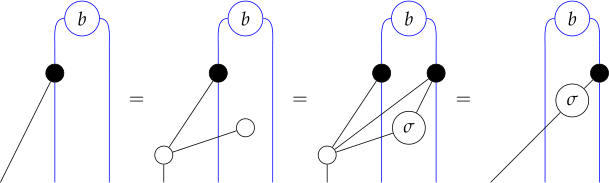
Proof

To see that ^B1 implies ^B2, note

c

That ^B2 implies ^B1 is obvious.

In particular, an invariant bilinear form ⟨?,?⟩ :H ⊗H →K on H is an H-invariant form under the adjoint action, in which case ^B2 says

⟨𝑥▹𝑦,𝑧⟩=∑(𝑥)⟨𝑥(1)𝑦𝜎(𝑥(2)),𝑧⟩=∑(𝑥)⟨𝑦,𝜎(𝑥(2))𝑧𝜎2(𝑥(1))⟩=⟨𝑦,𝜎(𝑥)▹𝑧⟩

Terminology

If H is autonomous, this is equivalent to saying 𝑏 is an H-invariant of (𝑉 ⊗𝑉)∗, i.e. under the action (𝑥𝑏)(𝑣,𝑤) =∑(𝑥)𝑏(𝜎(𝑥(2))𝑣,𝜎(𝑥(1))𝑤).

Proof

If 𝑏 is an H-invariant of (𝑉 ⊗𝑉)∗, then

∑(𝑥)𝑏(𝑥(1),𝑥(2))=(𝜎−1(𝑥)𝑏)(𝑣,𝑤)=𝜖(𝜎−1(𝑥))𝑏(𝑣,𝑤)=𝜖(𝑥)𝑏(𝑣,𝑤)

so ^B1 holds. Conversely if ^B1 holds, then

∑(𝑥)𝑏(𝜎(𝑥(2))𝑣,𝜎(𝑥(1))𝑤)=𝜖(𝜎(𝑥))𝑏(𝑣,𝑤)=𝜖(𝑥)𝑏(𝑣,𝑤)

so 𝑏 is an H-invariant of (𝑉 ⊗𝑉)∗.

Properties

  1. An H-invariant bilinear form 𝑏 :𝑉 ⊗𝑉 →K induces an H-morphism 𝑏♭ :𝑉 →𝑉∗ by currying.


#state/tidy | #lang/en | #SemBr