Module theory MOC
Induced module
Let 𝐴 be a 𝕂-monoid, 𝐵 ≤𝐴 be a 𝕂-submonoid, and 𝑉 be a 𝐵-module.
The 𝐴-module induced by the 𝐵-module 𝑉 is a canonical way of extending 𝑉 to accomodate a representation of 𝐴,
as formalized by the Universal property.1
We have the adjunction
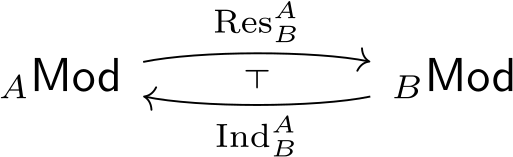
with the Restricted module.
More generally we can consider Change of ring along a ring homomorphism.
Universal property
Let 𝐴 be 𝕂-ring, 𝐵 ≤𝐴 be a 𝕂-subring, and 𝑉 be a 𝐵-module. The 𝐴-module induced by the 𝐵-module 𝑉 is a pair consisting of an 𝐴-module Ind𝐴𝐵𝑉 =𝐴 ⊗𝐵𝑉 and a 𝐵-Module homomorphism 𝜄 :𝑉 →Ind𝐴𝐵𝑉
such that given any 𝐴-module 𝑊 a 𝐵-module homomorphism 𝑓 :𝑉 →𝑊
factorizes uniquely through 𝜄 #m/def/ralg
%0A%20%20%20%20..%20controls%20(%24(%5Ctikztostart)!%5Cpv%7Bpos%7D!(%5Ctikztotarget)!%5Cpv%7Bheight%7D!270%3A(%5Ctikztotarget)%24)%0A%20%20%20%20and%20(%24(%5Ctikztostart)!1-%5Cpv%7Bpos%7D!(%5Ctikztotarget)!%5Cpv%7Bheight%7D!270%3A(%5Ctikztotarget)%24)%0A%20%20%20%20..%20(%5Ctikztotarget)%5Ctikztonodes%7D%7D%2C%0A%20%20%20%20settings%2F.code%3D%7B%5Ctikzset%7Bquiver%2F.cd%2C%231%7D%0A%20%20%20%20%20%20%20%20%5Cdef%5Cpv%23%231%7B%5Cpgfkeysvalueof%7B%2Ftikz%2Fquiver%2F%23%231%7D%7D%7D%2C%0A%20%20%20%20quiver%2F.cd%2Cpos%2F.initial%3D0.35%2Cheight%2F.initial%3D0%7D%0A%25%20TikZ%20arrowhead%2Ftail%20styles.%0A%5Ctikzset%7Btail%20reversed%2F.code%3D%7B%5Cpgfsetarrowsstart%7Btikzcd%20to%7D%7D%7D%0A%5Ctikzset%7B2tail%2F.code%3D%7B%5Cpgfsetarrowsstart%7BImplies%5Breversed%5D%7D%7D%7D%0A%5Ctikzset%7B2tail%20reversed%2F.code%3D%7B%5Cpgfsetarrowsstart%7BImplies%7D%7D%7D%0A%25%20TikZ%20arrow%20styles.%0A%5Ctikzset%7Bno%20body%2F.style%3D%7B%2Ftikz%2Fdash%20pattern%3Don%200%20off%201mm%7D%7D%0A%25%20https%3A%2F%2Fq.uiver.app%2F%23q%3DWzAsMyxbMCwwLCJWIl0sWzIsMCwiXFxvcGVyYXRvcm5hbWV7SW5kfV5BX0IgViJdLFsyLDIsIlciXSxbMCwxLCJcXGlvdGFfViJdLFswLDIsImYiLDJdLFsxLDIsIlxcZXhpc3RzIVxcYmFyIGYiLDAseyJzdHlsZSI6eyJib2R5Ijp7Im5hbWUiOiJkYXNoZWQifX19XV0%3D%0A%5Cbegin%7Btikzcd%7D%5Bampersand%20replacement%3D%5C%26%5D%0A%09V%20%5C%26%5C%26%20%7B%5Coperatorname%7BInd%7D%5EA_B%20V%7D%20%5C%5C%0A%09%5C%5C%0A%09%5C%26%5C%26%20W%0A%09%5Carrow%5B%22%7B%5Ciota_V%7D%22%2C%20from%3D1-1%2C%20to%3D1-3%5D%0A%09%5Carrow%5B%22f%22'%2C%20from%3D1-1%2C%20to%3D3-3%5D%0A%09%5Carrow%5B%22%7B%5Cexists!%5Cbar%20f%7D%22%2C%20dashed%2C%20from%3D1-3%2C%20to%3D3-3%5D%0A%5Cend%7Btikzcd%7D%0A#invert)
such that ¯𝑓 :Ind𝐴𝐵𝑉 →𝑊 is an 𝐴-module homomorphism.
This admits a unique extension to a functor Ind𝐴𝐵 :𝐵𝖬𝗈𝖽 →𝐴𝖬𝗈𝖽 such that 𝜄 :1 ⇒Ind𝐴𝐵 :𝐵𝖬𝗈𝖽 →𝐵𝖬𝗈𝖽 becomes a natural transformation.
Construction
Let 𝐴 ⊗𝕂𝑉 be the 𝕂-tensor product with the bilinear map ( ⊗) :𝐴 ×𝑉 →𝐴 ⊗𝕂𝑉.
Let 𝐾 denote the vector subspace generated by any elements of the form
𝑎𝑏⊗𝑣−𝑎⊗𝑏⋅𝑣
for any 𝑎 ∈𝐴, 𝑏 ∈𝐵, and 𝑣 ∈𝑉.
We construct the induced module as the quotient vector space
𝐴⊗𝐵𝑉=𝐴⊗𝕂𝑉𝐾
with its natural projection 𝜋 :𝐴 ⊗𝕂𝑉 ↠𝐴 ⊗𝐵𝑉.
The map
(⊗𝐵)=𝜋∘(⊗𝕂)
defines a representation of 𝐴,
and the inclusion is given by
𝜄:𝑉↪𝐴⊗𝐵𝑉𝑣↦1⊗𝐵𝑣
Proof of the universal property
Let 𝑊 be an 𝐴-module and 𝑓 :𝑉 →𝑊 be a 𝐵-module homomorphism.
Then for the above diagram to commute, we require that ¯𝑓(𝜄(𝑣)) =¯𝑓(1 ⊗𝐵𝑣) =𝑓(𝑣) for 𝑣 ∈𝑉.
For ¯𝑓 to be an 𝐴-module homomorphism, it follows ¯𝑓(𝑎 ⊗𝐵𝑣) =𝑎 ⋅𝑓(𝑣) for 𝑎 ∈𝐴 and 𝑣 ∈𝑉.
Since elements of this form span 𝐴 ⊗𝐵𝑉, this fully defines ¯𝑓, hence it is unique.
Graded structure
Let 𝐴 be a 𝔄-graded 𝕂-monoid, 𝐵 ≤𝐴 be unital graded subalgebra,
and 𝑉 be a graded 𝐵-module.
Then Ind𝐴𝐵𝑉 has a natural graded structure, where for any 𝑎 ∈𝐴𝛼 and 𝑣 ∈𝑉𝛽, deg(𝑎 ⊗𝐵𝑣) =𝛼 +𝛽.
See also
#state/tidy | #lang/en | #SemBr