Biot-Savart Law
Magnetic field from a circular wire loop
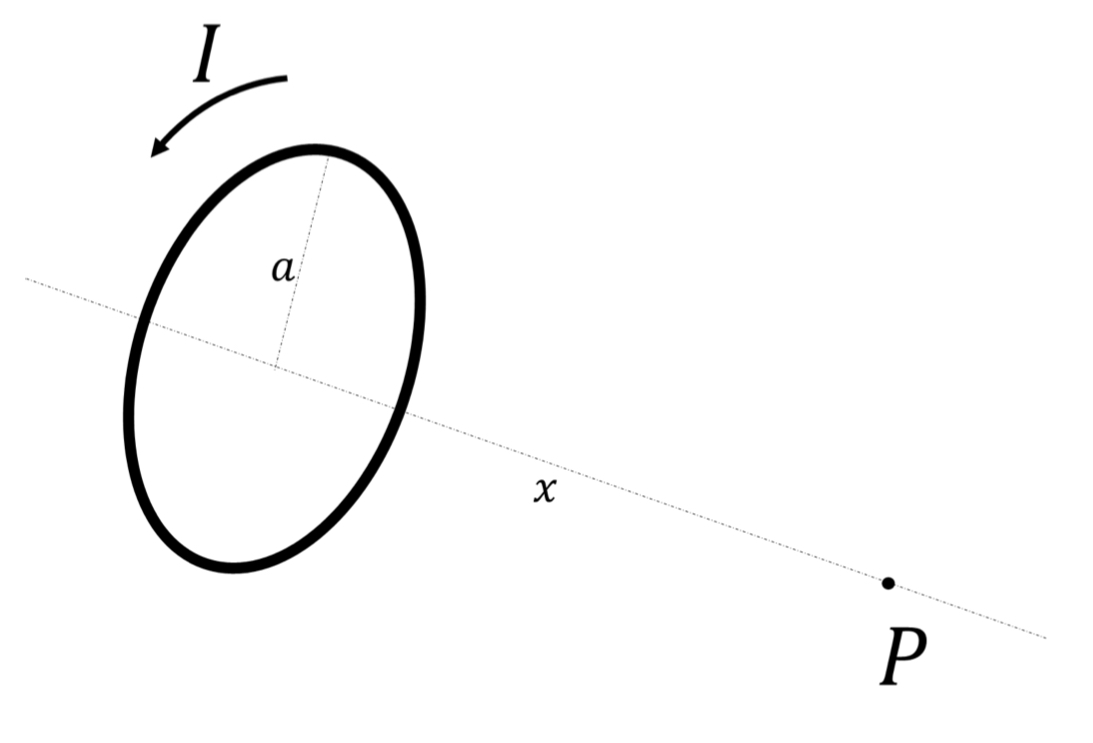 A circular conductor with current 𝐼, radius 𝑎 results in a magnetic field strength ⃗𝐁 at the point a length of 𝑥 along its "axis".1
The above situation yields a number of useful symmetries:
viz. any components of 𝑑⃗𝐁 arising from one point on the wire perpendicular to the axis will be canceled out by the 𝑑⃗𝐁 on the opposite side.
Therefore, ⃗𝐁 along this axis is always parallel to the axis itself.
Specifically, solving the Biot-Savart Law for this setup gives
∣⃗𝐁∣=𝜇0𝐼𝑎22(𝑎2+𝑥2)3/2
which, when 𝑥 =0, i.e. the field strength directly in the ring's centre, simplifies to
∣⃗𝐁∣=𝜇0𝐼2𝑎
The direction of the ⃗𝐁-field at any point along the axis can be determined by a right hand rule:
curl the fingers in the direction of current and the thumb points in the direction of the ⃗𝐁-field.
Note when 𝑥 ≫𝑎 this gives a 𝐵 ∝𝑥−3,
which is analogous to an electric dipole.
See Magnetic dipole moment.
⃗𝐁=𝜇0𝐼⃗𝐀2𝜋𝑥3
#state/tidy | #SemBr | #lang/en