Projective module
An
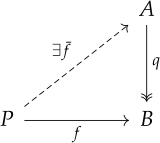
This is equivalent to any of the following1
𝑅 𝖬 𝗈 𝖽 ( 𝑃 , − ) - Any Module epimorphism
𝛼 : 𝑀 ↠ 𝑃 𝑃 𝑃 ⊕ 𝑄 ≅ 𝑅 ( 𝛼 ) 𝑄 𝛼 𝑅 𝖬 𝗈 𝖽 ( 𝑃 , − )
Proof
If ^P1 holds,
then taking
If ^P2 holds, consider an epimorphism
guarantees the required direct sum decomposition, giving ^P3.
Note that
it follows from ^P1 that ^P3 implies ^P4.
Noting that being a module epimorphism is the same as being a regular epimorphism, and that the latter must be preserved by exact functors, it is clear that ^P4 implies ^P3.
#state/develop | #lang/en | #SemBr
Footnotes
-
2011. Introduction to representation theory, §8.1, pp. 205–332 ↩