K-comonoid

Dual K-monoid of a K-comonoid

Let C be a K-comonoid. Then the Dual module C∗ naturally has the structure of a K-monoid. #m/thm/hopf We define the maps

𝜂:K→C∗𝜇:C∗⊗C∗→C∗

where

  1. 𝜂 =𝜖∗, i.e. ⟨1,𝑥⟩=𝜖(𝑥) for 𝑥 ∈C.
  2. 𝜇(𝑓 ⊗𝑔) =(𝑓 ⊗𝑔) ∘Δ, i.e. ⟨𝑓⋅𝑔,𝑥⟩=∑(𝑥)⟨𝑓,𝑥(1)⟩⟨𝑔,𝑥(2)⟩ for 𝑥 ∈C.
Proof

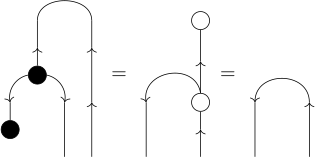
Even though C∗ may not be a true Duality in a monoidal category, we will use the string diagram notation given there. Left unitality is evident from

c

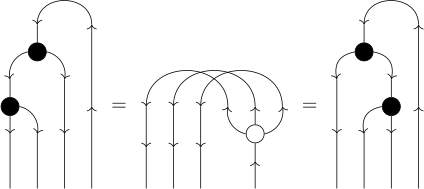
and right unitality is similar. Associativity is evident from
c

Therefore C∗ is in fact a K-monoid with this multiplication and unit.

One might assume that this dualizes nicely, but unfortunately the category K𝖬𝗈𝖽 is not strong enough this. If we have true dual objects as in 𝖥𝖵𝖾𝖼𝗍𝕂, everything falls out automatically by bending wires in string diagrams.


#state/tidy | #lang/en | #SemBr