Module theory MOC
K-tensor product of modules
Let 𝑀,𝑁 be modules over a commutative ring K.
The tensor product 𝑀 ⊗K𝑁 is an K-module such that the K-bilinear maps from 𝑀 ×𝑁 are in correspondence with the K-linear maps from 𝑀 ⊗K𝑁, as defined by the Universal property.1
A generalization for the 𝑅-tensor product of modules exists, but is not necessarily a module.
We recover this notion of tensor product as the Tensor product of bimodules.
Universal property
Let 𝑀,𝑁 be K-modules.
The tensor product is a pair consisting of an K-module 𝑀 ⊗K𝑁 together with an K-bilinear map ( ⊗) :𝑀 ×𝑁 →𝑀 ⊗K𝑁
such any K-bilinear map 𝜑 :𝑀 ×𝑁 →𝑃 factorizes uniquely through ( ⊗) #m/def/module
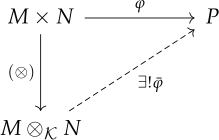
such that ――𝜑 is K-linear.
Construction
Let 𝑅(𝑀×𝑁) be the free module on 𝑀 ×𝑁 with the natural inclusion function 𝜄 :𝑀 ×𝑁 ↪𝑅(𝑀×𝑁).
Let 𝐾 denote the K-Submodule of 𝑅(𝑀×𝑁) generated by elements of the form
𝜄(𝑚,𝛼𝑛1+𝛽𝑛2)−𝛼𝜄(𝑚,𝑛1)−𝛽𝜄(𝑚,𝑛2);𝜄(𝛼𝑚1+𝛽𝑚2,𝑛)−𝛼𝜄(𝑚1,𝑛)−𝛽𝜄(𝑚2,𝑛);
for all 𝑚,𝑚1,𝑚2 ∈𝑀, 𝑛,𝑛1,𝑛2 ∈𝑁, 𝛼,𝛽 ∈𝑅.
We construct the tensor product as the quotient module
𝑀⊗K𝑁=K(𝑀×𝑁)/𝐾
with its natural projection 𝜋 :K(𝑀×𝑁) ↠𝑀 ⊗K𝑁,
so that the map
(⊗)=𝜋∘𝜄:𝑀×𝑁→𝑀⊗K𝑁
Proof of the universal property
By construction ( ⊗) is K-bilinear.
Let 𝜑 :𝑀 ×𝑁 →𝑃 be K-bilinear.
By the universal property of the free module we have a unique K-linear map ˜𝜑 such that the following commutes:
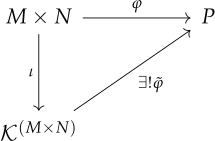
and by the K-bilinearity of 𝜑 it follows 𝐾 ≤𝑅𝖬𝗈𝖽ker˜𝜑,
so by the universal property of the quotient module ˜𝜑 factors uniquely through 𝜋,
yielding the commutative diagram
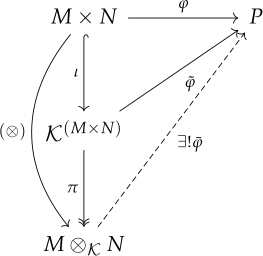
as required.
Properties
#state/tidy | #lang/en | #SemBr