Module theory MOC
𝑅-tensor product of modules
Unlike in the special case of the K-tensor product of modules,
the general tensor product of modules may itself lack module structure.
Let 𝑅 be a (noncommutative) ring,
𝑀 be a right 𝑅-module and 𝑁 be a left 𝑅-module.
The tensor product 𝑀 ⊗𝑅𝑁 is an abelian group such that the 𝑅-balanced maps from 𝑀 ×𝑁 are in correspondence with the group homomorphisms from 𝑀 ⊗𝑅𝑁, as defined by the Universal property.
Universal property
Let 𝑀 be a right 𝑅-module and 𝑁 be a left 𝑅-module.
The tensor product is a pair consisting of an abelian group 𝑀 ⊗𝑅𝑁 together with an 𝑅-balanced map ( ⊗) :𝑀 ×𝑁 →𝑀 ⊗𝑅𝑁
such that any 𝑅-balanced map 𝜑 :𝑀 ×𝑁 →𝐺 factorizes uniquely through ( ⊗) #m/def/module
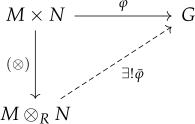
such that ――𝜑 is a group homomorphism.
Construction
Let ℤ(𝑀×𝑁) be a free ℤ-module free abelian group on 𝑀 ×𝑁 with the natural inclusion function 𝜄 :𝑀 ×𝑁 ↪ℤ(𝑀×𝑁).
Let 𝐾 denote the ℤ-Submodule (subgroup) of ℤ(𝑀×𝑁) generated by any elements of the form
𝜄(𝑚,𝑛+𝑛′)−𝜄(𝑚,𝑛)−𝜄(𝑚,𝑛′);𝜄(𝑚+𝑚′,𝑛)−𝜄(𝑚,𝑛)−𝜄(𝑚′,𝑛);𝜄(𝑚⋅𝑟,𝑛)−𝜄(𝑚,𝑟⋅𝑛);
for any 𝑚,𝑚′ ∈𝑀, 𝑛,𝑛′ ∈𝑁, 𝑟 ∈𝑅.
We construct the tensor product as the quotient ℤ-module
𝑀⊗𝑅𝑁=ℤ(𝑀×𝑁)/𝐾
with its natural projection 𝜋 :ℤ(𝑀×𝑁) ↠𝑀 ⊗𝑅𝑁,
so that the map
(⊗)=𝜋∘𝜄:𝑀×𝑁→𝑀⊗𝑅𝑁
Proof of the universal property
By construction ( ⊗) is 𝑅-balanced.
Let 𝜑 :𝑀 ×𝑁 →𝐺 be 𝑅-balanced.
By the universal property of the free module we have a unique ℤ-linear map ˜𝜑 such that the following commutes:
%0A%20%20%20%20..%20controls%20(%24(%5Ctikztostart)!%5Cpv%7Bpos%7D!(%5Ctikztotarget)!%5Cpv%7Bheight%7D!270%3A(%5Ctikztotarget)%24)%0A%20%20%20%20and%20(%24(%5Ctikztostart)!1-%5Cpv%7Bpos%7D!(%5Ctikztotarget)!%5Cpv%7Bheight%7D!270%3A(%5Ctikztotarget)%24)%0A%20%20%20%20..%20(%5Ctikztotarget)%5Ctikztonodes%7D%7D%2C%0A%20%20%20%20settings%2F.code%3D%7B%5Ctikzset%7Bquiver%2F.cd%2C%231%7D%0A%20%20%20%20%20%20%20%20%5Cdef%5Cpv%23%231%7B%5Cpgfkeysvalueof%7B%2Ftikz%2Fquiver%2F%23%231%7D%7D%7D%2C%0A%20%20%20%20quiver%2F.cd%2Cpos%2F.initial%3D0.35%2Cheight%2F.initial%3D0%7D%0A%25%20TikZ%20arrowhead%2Ftail%20styles.%0A%5Ctikzset%7Btail%20reversed%2F.code%3D%7B%5Cpgfsetarrowsstart%7Btikzcd%20to%7D%7D%7D%0A%5Ctikzset%7B2tail%2F.code%3D%7B%5Cpgfsetarrowsstart%7BImplies%5Breversed%5D%7D%7D%7D%0A%5Ctikzset%7B2tail%20reversed%2F.code%3D%7B%5Cpgfsetarrowsstart%7BImplies%7D%7D%7D%0A%25%20TikZ%20arrow%20styles.%0A%5Ctikzset%7Bno%20body%2F.style%3D%7B%2Ftikz%2Fdash%20pattern%3Don%200%20off%201mm%7D%7D%0A%25%20https%3A%2F%2Fq.uiver.app%2F%23q%3DWzAsMyxbMCwwLCJNIFxcdGltZXMgTiJdLFswLDIsIlxcbWF0aGJiIFpbTSBcXHRpbWVzIE5dIl0sWzIsMCwiRyJdLFswLDEsIlxcaW90YSIsMl0sWzAsMiwiXFx2YXJwaGkiXSxbMSwyLCJcXGV4aXN0cyFcXHRpbGRlXFx2YXJwaGkiLDIseyJzdHlsZSI6eyJib2R5Ijp7Im5hbWUiOiJkYXNoZWQifX19XV0%3D%0A%5Cbegin%7Btikzcd%7D%5Bampersand%20replacement%3D%5C%26%5D%0A%09%7BM%20%5Ctimes%20N%7D%20%5C%26%5C%26%20G%20%5C%5C%0A%09%5C%5C%0A%09%7B%5Cmathbb%20Z%5BM%20%5Ctimes%20N%5D%7D%0A%09%5Carrow%5B%22%5Cvarphi%22%2C%20from%3D1-1%2C%20to%3D1-3%5D%0A%09%5Carrow%5B%22%5Ciota%22'%2C%20from%3D1-1%2C%20to%3D3-1%5D%0A%09%5Carrow%5B%22%7B%5Cexists!%5Ctilde%5Cvarphi%7D%22'%2C%20dashed%2C%20from%3D3-1%2C%20to%3D1-3%5D%0A%5Cend%7Btikzcd%7D%0A#invert)
and by the 𝑅-balance of 𝜑 it follows 𝐾 ≤ker˜𝜑,
so by the universal property of the quotient module ˜𝜑 factors uniquely through 𝜋,
yielding the commutative diagram
%0A%20%20%20%20..%20controls%20(%24(%5Ctikztostart)!%5Cpv%7Bpos%7D!(%5Ctikztotarget)!%5Cpv%7Bheight%7D!270%3A(%5Ctikztotarget)%24)%0A%20%20%20%20and%20(%24(%5Ctikztostart)!1-%5Cpv%7Bpos%7D!(%5Ctikztotarget)!%5Cpv%7Bheight%7D!270%3A(%5Ctikztotarget)%24)%0A%20%20%20%20..%20(%5Ctikztotarget)%5Ctikztonodes%7D%7D%2C%0A%20%20%20%20settings%2F.code%3D%7B%5Ctikzset%7Bquiver%2F.cd%2C%231%7D%0A%20%20%20%20%20%20%20%20%5Cdef%5Cpv%23%231%7B%5Cpgfkeysvalueof%7B%2Ftikz%2Fquiver%2F%23%231%7D%7D%7D%2C%0A%20%20%20%20quiver%2F.cd%2Cpos%2F.initial%3D0.35%2Cheight%2F.initial%3D0%7D%0A%25%20TikZ%20arrowhead%2Ftail%20styles.%0A%5Ctikzset%7Btail%20reversed%2F.code%3D%7B%5Cpgfsetarrowsstart%7Btikzcd%20to%7D%7D%7D%0A%5Ctikzset%7B2tail%2F.code%3D%7B%5Cpgfsetarrowsstart%7BImplies%5Breversed%5D%7D%7D%7D%0A%5Ctikzset%7B2tail%20reversed%2F.code%3D%7B%5Cpgfsetarrowsstart%7BImplies%7D%7D%7D%0A%25%20TikZ%20arrow%20styles.%0A%5Ctikzset%7Bno%20body%2F.style%3D%7B%2Ftikz%2Fdash%20pattern%3Don%200%20off%201mm%7D%7D%0A%25%20https%3A%2F%2Fq.uiver.app%2F%23q%3DWzAsNCxbMCwwLCJNIFxcdGltZXMgTiJdLFswLDIsIlxcbWF0aGJiIFpbTSBcXHRpbWVzIE5dIl0sWzIsMCwiRyJdLFswLDQsIk0gXFxvdGltZXNfUiBOIl0sWzAsMSwiXFxpb3RhIiwyXSxbMCwyLCJcXHZhcnBoaSJdLFsxLDIsIlxcdGlsZGVcXHZhcnBoaSIsMl0sWzEsMywiXFxwaSIsMl0sWzMsMiwiXFxleGlzdHMhXFxiYXIgXFx2YXJwaGkiLDIseyJzdHlsZSI6eyJib2R5Ijp7Im5hbWUiOiJkYXNoZWQifX19XSxbMCwzLCIoXFxvdGltZXMpIiwyLHsiY3VydmUiOjV9XV0%3D%0A%5Cbegin%7Btikzcd%7D%5Bampersand%20replacement%3D%5C%26%5D%0A%09%7BM%20%5Ctimes%20N%7D%20%5C%26%5C%26%20G%20%5C%5C%0A%09%5C%5C%0A%09%7B%5Cmathbb%20Z%5BM%20%5Ctimes%20N%5D%7D%20%5C%5C%0A%09%5C%5C%0A%09%7BM%20%5Cotimes_R%20N%7D%0A%09%5Carrow%5B%22%5Cvarphi%22%2C%20from%3D1-1%2C%20to%3D1-3%5D%0A%09%5Carrow%5B%22%5Ciota%22'%2C%20from%3D1-1%2C%20to%3D3-1%5D%0A%09%5Carrow%5B%22%7B(%5Cotimes)%7D%22'%2C%20curve%3D%7Bheight%3D30pt%7D%2C%20from%3D1-1%2C%20to%3D5-1%5D%0A%09%5Carrow%5B%22%7B%5Ctilde%5Cvarphi%7D%22'%2C%20from%3D3-1%2C%20to%3D1-3%5D%0A%09%5Carrow%5B%22%5Cpi%22'%2C%20from%3D3-1%2C%20to%3D5-1%5D%0A%09%5Carrow%5B%22%7B%5Cexists!%5Cbar%20%5Cvarphi%7D%22'%2C%20dashed%2C%20from%3D5-1%2C%20to%3D1-3%5D%0A%5Cend%7Btikzcd%7D%0A#invert)
as required.
Tensor product of bimodules
Note that if 𝑀 is a (𝑇,𝑅)-bimodule and 𝑅 is a (𝑅,𝑆)-bimodule then 𝑀 ⊗𝑅𝑁 is naturally equipped with the structure of a (𝑇,𝑆)-bimodule.
If 𝑅 is commutative, then we recover the K-tensor product of modules by considering 𝑅-bimodules 𝑀 and 𝑁 this way.
#state/develop | #lang/en | #SemBr