Representation theory of finite symmetric groups
Young operator
Let
and the column antisymmetrizer
then the Young operator is given by #m/def/rep/sym
Notation
The partition subscripts will typically be written out as a sum for the purpose of these notes, e.g.
A practical way to do pen-and-paper calculations is with a Birdtrack notation. If single-box symmetrizers and antisymmetrizers are drawn, each line passes through exactly one symmetrizer and exactly one antisymmetrizer. Each (anti)symmetrizer corresponds to a different row (column), with the number of lines passing through given by the number of boxes therein.
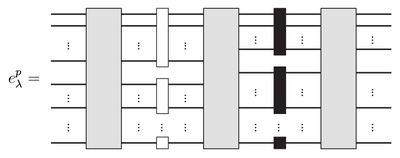
Properties
𝐻 𝑝 𝜆 = 𝑝 𝐻 𝜆 𝑝 − 1 𝑉 𝑝 𝜆 = 𝑝 𝑉 𝜆 𝑝 − 1 𝑆 𝑛 𝐻 𝑝 𝜆 ∩ 𝑉 𝑝 𝜆 = { 𝑒 } 𝔢 𝑝 𝜆 = 𝛿 𝑝 ∗ 𝔢 𝜆 ∗ 𝛿 𝑝 − 1 𝔰 𝑝 𝜆 𝔞 𝑝 𝜆 𝐻 𝑝 𝜆 𝑉 𝑝 𝜆 𝔰 𝑝 𝜆 𝔞 𝑝 𝜆 - The young operators
𝔢 𝑝 𝜆 - The irreps generated by
𝔢 𝑝 𝜆 𝔢 𝑞 𝜇 𝜆 = 𝜇 𝑝 𝑞
Proof
The proof is most intuitive with birdtrack arguments.
For 4., we expands the convolution as follows
for the term
𝑞 𝑞 𝔢 𝑝 𝜆 𝑞 − 𝔢 𝑝 𝜆 - A combination of
2.and3.gives at most a sign change
hence
For 5. we will show that if
Now since
#state/tidy | #lang/en | #SemBr