Module theory MOC
Change of ring
Suppose 𝜌 :𝑅 →𝑆 is a ring homomorphism.
For any 𝑆-module 𝑉, we have a (left) 𝑅-module 𝜌∗𝑉 by restriction of scalars. Explicitly, 𝜌∗𝑉 is the 𝑅-module with the same underlying abelian group as 𝑉
and the 𝑅-action defined by 𝑥𝑣 =𝜌(𝑥)𝑣.
Since any 𝑆-morphism 𝑉 →𝑊 becomes an 𝑅-morphism of 𝜌∗𝑉 →𝜌∗𝑊, we have a “forgetful” faithful functor 𝜌∗ :𝑆𝖬𝗈𝖽 →𝑅𝖬𝗈𝖽.
In fact, this functor has both left and right adjoints, giving us an adjoint triple
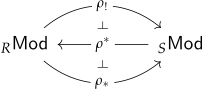
where
Note that is some cases 𝜌∗ ≅𝜌! are naturally isomorphic:
When 𝜌 is a Frobenius extension.
Extension of scalars
Let 𝜌 :𝑅 →𝑆 be a ring homomorphism,
and let 𝑆𝑆𝑅 denote 𝑆 regarded as a (𝑆,𝑅)-bimodule, where the right action is given by 𝑠 ◃𝑟 =𝑠 𝜌(𝑟).
We define 𝜌! from the Tensor product of bimodules as the functor
𝜌!:=𝑆𝑆𝑅⊗𝑅?.
It follows for an 𝑅-module 𝑉, we have the 𝑆-action
𝑠1(𝑠2⊗𝑣)=𝑠1𝑠2⊗𝑣
for 𝑥 ∈𝑆, 𝑦 ∈𝑅, and 𝑣 ∈𝑉.
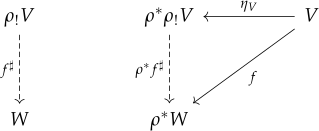
The unit of the adjunction 𝜌! ⊣𝜌∗ is the (not necessarily injective) “inclusion,” with components
𝜂𝑉:𝑉→𝜌∗𝜌!(𝑉)𝑣↦1⊗𝑣.
Proof of adjunction
Suppose 𝑊 is a 𝑆-module and 𝑓 :𝑉 →𝜌∗𝑊 is an 𝑅-morphism.
The right diagram says that for 𝑣 ∈𝑉,
𝑓(1⊗𝑣)=𝑓♯𝜂𝑉(𝑣)=𝑓(𝑣).which by 𝑆-linearity uniquely defined 𝑓.
Coëxtension of scalars
Let 𝜌 :𝑅 →𝑆 be a ring homomorphism,
and let 𝑅𝑆 denote 𝑆 regarded as a left 𝑅-module via the action 𝑥 ▹𝑦 =𝜌(𝑥)𝑦.
We define the functor 𝜌∗ :𝑅𝖬𝗈𝖽 →𝑆𝖬𝗈𝖽 so that
- the image 𝜌∗𝑉 of an 𝑅-module 𝑉 is the 𝑆-module with underlying abelian group 𝑅𝖬𝗈𝖽(𝑅𝑆,𝑉) and 𝑆-action 𝑠1 ▹𝑓 =𝑠2 ↦𝑓(𝑠2𝑠1).1
- the image 𝜌∗𝑓 of an 𝑅-morphism 𝑓 :𝑉 →𝑊 is the 𝑆-morphism with underlying group homomorphism
𝑅𝖬𝗈𝖽(𝑅𝑆,𝑔):𝑅𝖬𝗈𝖽(𝑅𝑆,𝑉)→𝑅𝖬𝗈𝖽(𝑅𝑆,𝑊)𝑓↦𝑔∘𝑓.
Proof of 𝑆-linearity
To reduce parentheses, the action ▹ takes precedence over application of functions.
To see that 𝜌∗𝑉 has a valid 𝑆-action:
closure follows from
𝑠1▹𝑓(𝑟1▹𝑠2+𝑟2▹𝑠3)=𝑠1▹𝑓(𝜌(𝑟1)𝑠2+𝜌(𝑟2)𝑠3)=𝑓(𝜌(𝑟1)𝑠2𝑠1+𝜌(𝑟2)𝑠3𝑠1)=𝑟1𝑓(𝑠2𝑠1)+𝑟2𝑓(𝑠3𝑠1)=𝑟1(𝑠1▹𝑓)(𝑠2)+𝑟2(𝑠1▹𝑓)(𝑠3);unitality follows immediately;
multiplicativity follows from
𝑠1𝑠2▹𝑓(𝑠3)=𝑓(𝑠3𝑠1𝑠2)=𝑠2▹𝑓(𝑠3𝑠1)=𝑠1▹𝑠2▹𝑓(𝑠3);scalar distributivity follows from
𝑠1▹𝑓1+𝑓2(𝑠2)=(𝑓1+𝑓2)(𝑠2𝑠1)=𝑓1(𝑠2𝑠1)+𝑓2(𝑠2𝑠1)=𝑠1▹𝑓1(𝑠2)+𝑠1▹𝑓2(𝑠2)=(𝑠1▹𝑓1+𝑠1▹𝑓2)(𝑠2);vector distributivity follows from
(𝑠1+𝑠2)▹𝑓(𝑠3)=𝑓(𝑠3(𝑠1+𝑠2))=𝑓(𝑠2𝑠1+𝑠3𝑠2)=𝑓(𝑠2𝑠1)+𝑓(𝑠3𝑠2)=𝑠1▹𝑓(𝑠3)+𝑠2▹𝑓(𝑠1).That 𝜌∗𝑔 is well-defined and preserved addition follows from the internal-hom of 𝖠𝖻.
To see that 𝜌∗𝑔 preserves the 𝑆-action,
𝜌∗𝑔(𝑠1▹𝑓)(𝑠2)=𝑔∘(𝑠1▹𝑓)(𝑠2)=𝑔(𝑓(𝑠2𝑠1))=𝑠1▹(𝑔∘𝑓)(𝑠2)as required.
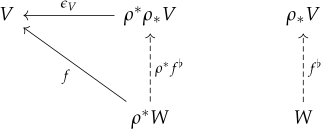
The coünit of the adjunction 𝜌∗ ⊣𝜌∗ is the “projection” with components
𝜖𝑉:𝜌∗𝜌∗𝑉→𝑉𝑓↦𝑓(1)
Proof of 𝑅-linearity and adjunction
To see that 𝜖𝑉 is 𝑅-linear, it suffices to note
𝜖𝑉(𝜌(𝑟)▹𝑓1)=𝜌(𝑟)▹𝑓(1)=𝑓(𝜌(𝑟))=𝑟𝑓(1)=𝑟1𝜖𝑉(𝑓)by the 𝑅-linearity of 𝑓.
Next we show that 𝜖𝑉 is a coünit of adjunction.
Suppose that 𝑊 is a 𝑆-module and 𝑓 :𝜌∗𝑊 →𝑉 is an 𝑅-morphism.
The left diagram says that for 𝑤 ∈𝑊 we have
𝑓♭(𝑤)(1)=𝜖𝑉𝑓♭(𝑤)=𝑓(𝑤)∈𝜌∗𝑉=𝑅𝖬𝗈𝖽(𝑅𝑆,𝑉)This determines the 𝑓♭(𝑤) completely, as for any 𝑠 ∈𝑆 we have
𝑓♭(𝑠𝑤)(1)=𝑠▹𝑓♭(𝑤)(1)=𝑓♭(𝑤)(𝑠)by 𝑆-linearity.
#state/tidy | #lang/en | #SemBr