Ring

Idempotent

An idempotent 𝑒 βˆˆπ‘… of a ring 𝑅 is an element satisfying (𝑒)2 =𝑒. #m/def/ring

Further terminology

Effect on modules

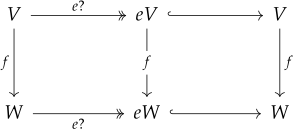
Let 𝑒 βˆˆπ‘… be an idempotent. Then if 𝑓 :𝑉 β†’π‘Š is a (left) 𝑅-morphism, then 𝑓(𝑒𝑉) βŠ†π‘’π‘Š. Thus left multiplication by 𝑒 forms an endofunctor on π‘…π–¬π—ˆπ–½, equipped with natural transformations from and to the identity endofunctor for projection and inclusion.

c|https://q.uiver.app/#q=WzAsNixbMCwwLCJWIl0sWzAsMiwiVyJdLFsyLDAsImVWIl0sWzIsMiwiZVciXSxbNCwwLCJWIl0sWzQsMiwiVyJdLFswLDEsImYiLDJdLFsyLDMsImYiLDFdLFsxLDMsImV7P30iLDIseyJzdHlsZSI6eyJoZWFkIjp7Im5hbWUiOiJlcGkifX19XSxbMCwyLCJlez99IiwwLHsic3R5bGUiOnsiaGVhZCI6eyJuYW1lIjoiZXBpIn19fV0sWzMsNSwiIiwxLHsic3R5bGUiOnsidGFpbCI6eyJuYW1lIjoiaG9vayIsInNpZGUiOiJ0b3AifX19XSxbMiw0LCIiLDEseyJzdHlsZSI6eyJ0YWlsIjp7Im5hbWUiOiJob29rIiwic2lkZSI6InRvcCJ9fX1dLFs0LDUsImYiXV0=

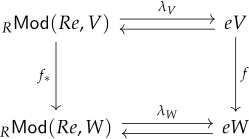
Moreover in 𝖠𝖻 we have a natural isomorphism

c|https://q.uiver.app/#q=WzAsNCxbMCwwLCJcXGxNb2R7Un0oUmUsVikiXSxbMCwyLCJcXGxNb2R7Un0oUmUsVykiXSxbMiwwLCJlViJdLFsyLDIsImVXIl0sWzAsMiwiXFxsYW1iZGFfViIsMCx7Im9mZnNldCI6LTF9XSxbMSwzLCJcXGxhbWJkYV9XIiwwLHsib2Zmc2V0IjotMX1dLFsyLDMsImYiXSxbMCwxLCJmXyoiLDJdLFsyLDAsIiIsMSx7Im9mZnNldCI6LTF9XSxbMywxLCIiLDAseyJvZmZzZXQiOi0xfV1d

where for 𝑔 βˆˆπ‘…π–¬π—ˆπ–½(𝑅𝑒,𝑉) we have πœ†π‘‰(𝑔) =𝑔(𝑒).

Proof

The functoriality follows from 𝑓(𝑒𝑉) =𝑒𝑓(𝑉) βŠ†π‘’π‘Š, and the first diagram commutes by the fact 𝑉 and π‘Š are left 𝑅-modules.

To see that πœ†π‘‰ has the correct codomain, note that for 𝑔 :𝑅𝑒 →𝑒𝑉 we have 𝑒𝑔(𝑒) =𝑔(𝑒2) =𝑔(𝑒). Clearly πœ†π‘‰ is a group homomorphism. Also, πœ†π‘‰ is a group monomorphism, because if 𝑔(𝑒) =𝑔′(𝑒) then 𝑔(π‘Ÿπ‘’) =π‘Ÿπ‘”(𝑒) =π‘Ÿπ‘”β€²(𝑒) =𝑔′(π‘Ÿπ‘’) for any π‘Ÿ βˆˆπ‘…. To see that it is a group epimorphism, let 𝑒𝑣 βˆˆπ‘’π‘‰. Then we can define 𝑔 :𝑅𝑒 →𝑉 :π‘Ÿπ‘’ β†¦π‘Ÿπ‘’π‘£, wherefore πœ†π‘‰(𝑔) =𝑔(𝑒) =𝑒2𝑣 =𝑒𝑣.

Finally, naturality follows from the fact π‘“πœ†π‘‰(𝑔) =𝑓𝑔(𝑒) =πœ†π‘Šπ‘“βˆ—π‘”.

The case when 𝑉 =𝑅𝑒 gives a ring antiΓ―somorphism

πœ†π‘…π‘’:End𝑅⁑(𝑅𝑒)𝐨𝐩≅𝑒𝑅𝑒
Proof

To see that πœ†π‘…π‘’ is a ring antiΓ―somorphism, let 𝑔,β„Ž ∈End𝑅⁑(𝑅𝑒). Then

πœ†π‘…π‘’(π‘”β„Ž)=π‘”β„Ž(𝑒)=π‘”β„Ž(𝑒2)=𝑔(β„Ž(𝑒)𝑒)=β„Ž(𝑒)𝑔(𝑒)=πœ†π‘…π‘’(β„Ž)πœ†π‘…π‘’(𝑔)

as required.

See also


#state/tidy | #lang/en | #SemBr