Topology MOC

Continuity

In its most general form, a function between topological spaces 𝑓 :𝑋 β†’π‘Œ is continuous1 at a point 𝑐 βˆˆπ‘‹ iff. for every (open) neighbourhood 𝑉 of 𝑓(𝑐), there exists an (open) neighbourhood π‘ˆ of 𝑐, such that 𝑓(π‘ˆ) βŠ†π‘‰.2 #m/def/topology Intuitively, you can move a small amount in any direction from 𝑐 and end up close to 𝑓(𝑐).
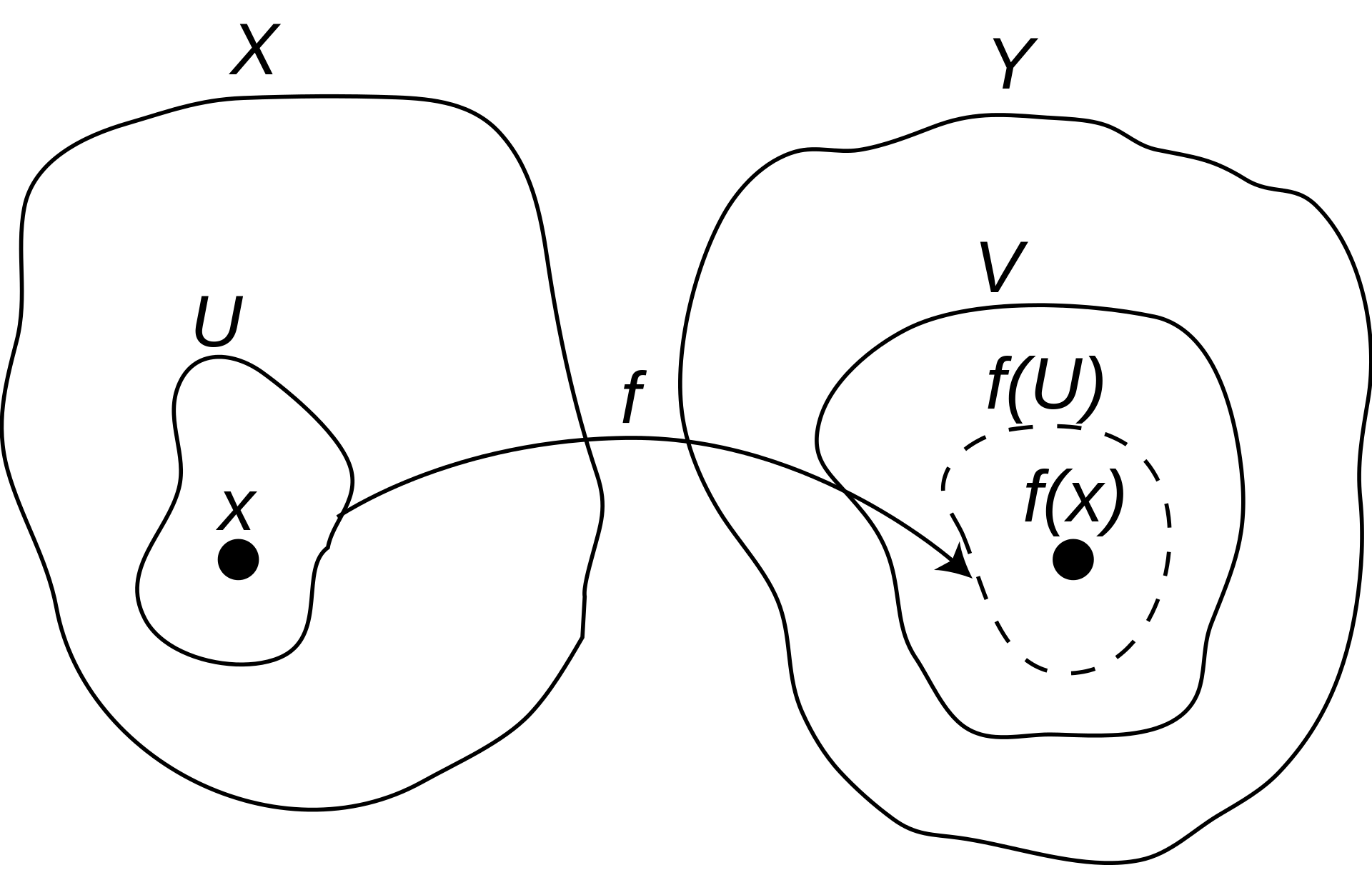
A function is continuous iff. it is continuous at every point in its domain, or equivalently iff. the preΓ―mage of every open set is open. #m/thm/topology π–³π—ˆπ—‰ has such functions as its morphisms. We write 𝐢(ℝ) to refer to the3 Function space of continuous functions on ℝ.

Proof of equivalence of open and general neighbourhood pointwise definitions

Let (𝑋,T𝑋) and (π‘Œ,TY) be topological spaces, and 𝑓 :𝑋 β†’π‘Œ.

First assume for every open neighbourhood 𝑉 ∈Tπ‘Œ of 𝑓(𝑐), there exists an open neighbourhood π‘ˆ ∈T𝑋 of 𝑐, such that 𝑓(π‘ˆ) βŠ†π‘‰. Given an arbitrary neighbourhood 𝑉′ of 𝑓(𝑐), there exists an open neighbourhood 𝑉 such that π‘₯ βˆˆπ‘‰ βŠ†π‘‰β€². Thence there exists an open neighbourhood π‘ˆ of 𝑐, such that 𝑓(π‘ˆ) βŠ†π‘‰ βŠ†π‘‰β€². Therefore for every neighbourhood 𝑉′ of 𝑓(𝑐), there exists a neighbourhood π‘ˆ of 𝑐, such that 𝑓(π‘ˆ) βŠ†π‘‰β€².

For the converse, assume for every neighbourhood 𝑉 of 𝑓(𝑐), there exists a neighbourhood π‘ˆβ€² of 𝑐, such that 𝑓(π‘ˆ) βŠ†π‘‰. Let 𝑉 be an open neighbourhood of 𝑓(𝑐). Then there exists a neighbourhood π‘ˆβ€² of 𝑐 such that 𝑓(π‘ˆβ€²) βŠ†π‘‰. It follows there exists an open neighbourhood π‘ˆ βŠ†π‘ˆβ€² of 𝐢, such that 𝑓(π‘ˆ) βŠ†π‘‰. Therefore for every open neighbourhood 𝑉 of 𝑓(𝑐), there exists an open neighbourhood π‘ˆ of 𝑐, such that 𝑓(π‘ˆ) βŠ†π‘‰.

Proof of equivalence of pointwise and preΓ―mage definition

Let (𝑋,T𝑋) and (π‘Œ,TY) be topological spaces, and 𝑓 :𝑋 β†’π‘Œ.

First assume the preΓ―mage of every open set is open. Let some 𝑐 βˆˆπ‘‹, and 𝑉 be an open neighbourhood of 𝑓(𝑐). The preΓ―mage π‘ˆ =π‘“βˆ’1(𝑉) is then an open neighbourhood of 𝑐, and 𝑓(π‘ˆ) =𝑓(π‘“βˆ’1(𝑉)) βŠ†π‘‰ (image of preΓ―mage). Therefore, given any 𝑐 βˆˆπ‘‹ and any open neighbourhood 𝑉 of 𝑓(𝑐), there exists an open neighbourhood π‘ˆ of 𝑐 such that 𝑓(π‘ˆ) βŠ†π‘‰.

For the converse, assume given any 𝑐 βˆˆπ‘‹ and any open neighbourhood 𝑉 of 𝑓(𝑐), there exists an open neighbourhood π‘ˆ of 𝑐 such that 𝑓(π‘ˆ) βŠ†π‘‰. Let 𝑉 ∈Tπ‘Œ be an open set. For every 𝑐 βˆˆπ‘“βˆ’1(𝑉), let π‘ˆπ‘ be an open neighbourhood of 𝑐 such that 𝑓(π‘ˆπ‘) βŠ†π‘‰. Take the union π‘ˆ =β‹ƒπ‘βˆˆπ‘“βˆ’1(𝑉)π‘ˆπ‘, which is an open neighbourhood of every 𝑐 βˆˆπ‘“βˆ’1(𝑉), whence π‘“βˆ’1(𝑉) βŠ†π‘ˆ Since every 𝑓(π‘ˆπ‘) βŠ†π‘‰ it follows that 𝑓(π‘ˆ) βŠ†π‘‰, whence π‘ˆ βŠ†π‘“βˆ’1(𝑉). Thus π‘ˆ =π‘“βˆ’1(𝑉) is open. Therefore the preΓ―mage of every open set is open.

A continuous bijection with a continuous inverse is a Homeomorphism4.

Special cases

In a metric space

If (𝑋,𝑑𝑋) and (π‘Œ,π‘‘π‘Œ) are metric spaces then the definition may be restated as

A function 𝑓 :𝑋 β†’π‘Œ is continuous at a point 𝑐 βˆˆπ‘‹ iff. for every πœ– >0 there exists 𝛿 >0 such that 𝑓(𝐡𝛿(𝑐)) βŠ†π΅πœ–(𝑓(𝑐)), i.e. 𝑓(π‘₯) βˆˆπ΅πœ–(𝑓(𝑐)) for any π‘₯ βˆˆπ΅π›Ώ(𝑐).

In metric spaces continuity is equivalent to Sequential continuity, namely a function is continuous at a point 𝑐 iff. it is sequentially continuous at that point.

In the real numbers

Intuitively, a function is continuous if it has no gaps, i.e. for 𝑓 :ℝ →ℝ you can sketch the function without the pen leaving the page. More formally continuity is defined in terms of Limits (Calculus). A function 𝑓 is continuous at π‘Ž iff.

limπ‘₯β†’π‘Žπ‘“(π‘₯)=𝑓(π‘Ž)

and 𝑓 is itself continuous iff. it is continuous at all points in its domain.

A function which is differentiable at π‘Ž is continuous at π‘Ž, but the converse is not necessarily true

differentiable⟹continuous

Hypernyms include


#state/tidy | #SemBr | #lang/en

Footnotes

  1. German stetig in π‘₯ ↩

  2. Using the notation of an Image. Can be restates as 𝑓(π‘₯) βˆˆπ‘‰ for any π‘₯ βˆˆπ‘ˆ. ↩

  3. well, a ↩

  4. Not to be confused with homomorphism. ↩